
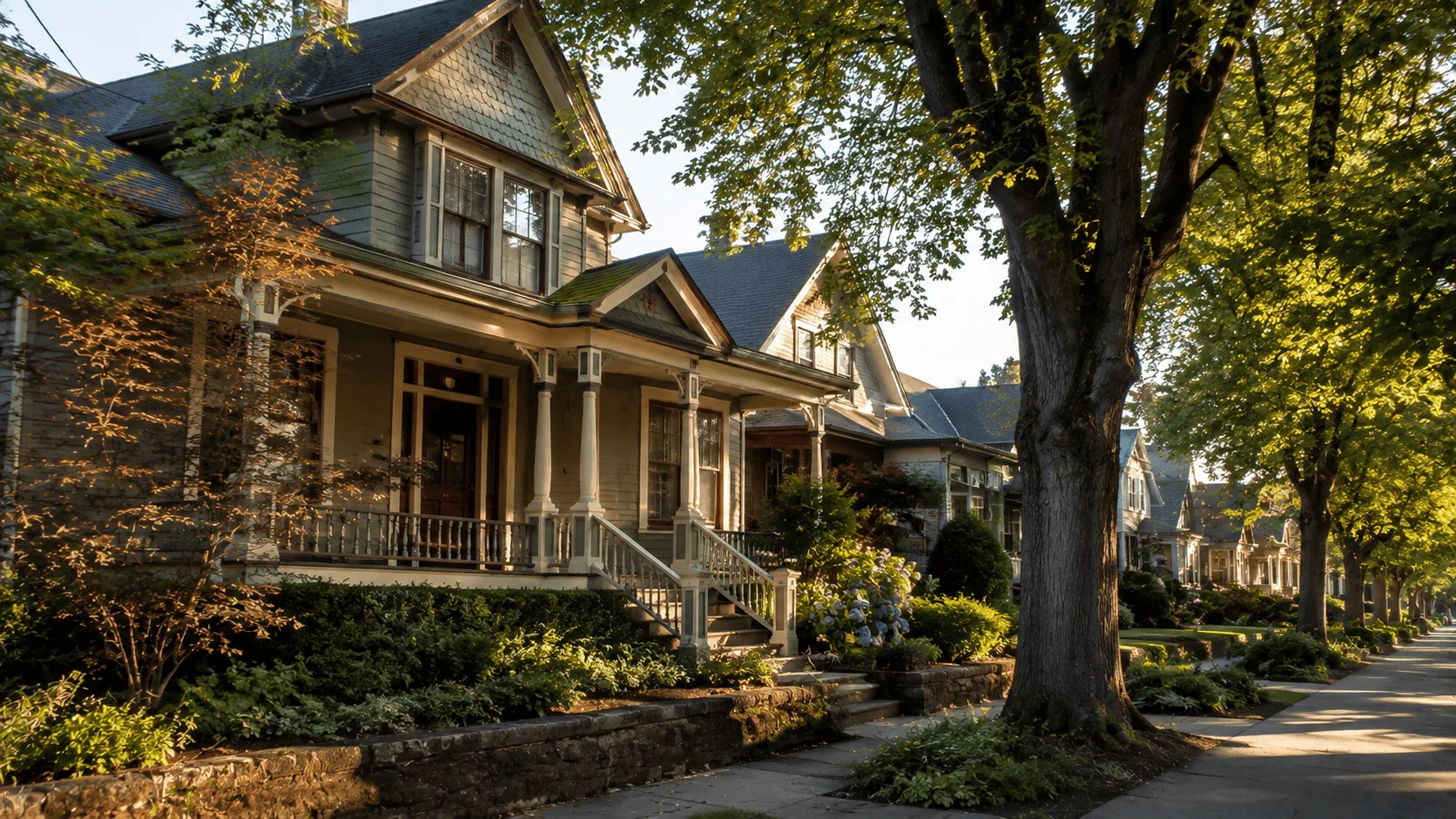
Historic Downtown Albany, Oregon: The Neighborhood Guide for Buyers
Monteith and Hackleman districts, riverfront access, Victorian homes, and a walkable core — what buyers need to know before purchasing in Historic Downtown Albany.
What Makes Historic Downtown Albany Different from Every Other Albany Neighborhood
Every Albany neighborhood has an identity. North Albany is new construction and schools. South Albany is value and established streets. Knox Butte is family-oriented growth. Historic Downtown is something else entirely — a walkable, character-rich urban core built over 150 years of Willamette Valley history, where a Craftsman bungalow from 1912 sits three blocks from the riverfront path and two blocks from the Saturday farmers market. It is the only neighborhood in Albany where you can genuinely leave your car in the garage for an entire weekend.
Historic Downtown Albany comprises two formally designated historic districts: the Monteith District and the Hackleman District. Both are listed on the National Register of Historic Places. The Monteith District covers the area around First and Second Avenues near the Willamette River, named for Thomas Monteith who platted the original townsite. The Hackleman District extends south and east, covering the denser residential blocks of Victorian-era Albany. Together they contain over 700 historic homes spanning Queen Anne, Craftsman, Italianate, and Colonial Revival architectural styles — the largest and most intact collection of Victorian-era architecture in Oregon west of the Cascades.
Home Prices in Historic Downtown Albany in 2026
Historic Downtown Albany offers a wider price range than most Albany neighborhoods because the housing stock varies dramatically in condition, size, and renovation status. A two-bedroom, 1,100 square foot Craftsman bungalow in original condition (needing updates) can be found in the $310,000–$360,000 range. A fully renovated four-bedroom Victorian on a corner lot runs $480,000–$560,000. The spread reflects the renovation premium — updated kitchens, modernized systems, and restored historic detail command 20–30% more than comparable unrenovated properties in the same block.
The per-square-foot value in Historic Downtown often beats newer Albany neighborhoods when condition is held constant. A well-renovated 1,600 square foot Craftsman in the Hackleman District at $420,000 represents better value on a price-per-square-foot basis than a comparable new construction home in Knox Butte at $495,000 — and offers character and location that new construction cannot replicate. The trade-off is maintenance complexity: older homes require more active upkeep, older plumbing and electrical systems present ongoing management requirements, and renovation projects must navigate historic district design guidelines that restrict certain exterior changes.
The Monteith District vs. the Hackleman District: What's the Difference?
Both districts share the same architectural era and historic designation, but they have distinct micro-characters worth understanding before you search. The Monteith District occupies the original townsite blocks closest to the Willamette River and First Avenue — the most walkable section of downtown Albany, with direct access to Monteith Riverpark, the Dave Clark Riverfront Path, downtown restaurants, and the Saturday farmers market. Homes in the Monteith District tend to be slightly larger on average and sit on the oldest platted lots in the city. This is the section of Historic Downtown that draws the most buyer attention and commands the highest prices.
The Hackleman District covers the adjacent residential blocks extending south and east from downtown, roughly bounded by the rail corridor and Salem Avenue. It is quieter, more residential in character, and slightly more accessible in price — while sharing the same architectural stock and historic designation. For buyers who want the Historic Downtown character and walkability but find Monteith District prices stretched, the Hackleman District frequently offers comparable homes at a 5–10% discount. The two districts are separated by a short walk, not a meaningful lifestyle difference.
What Buyers Need to Know About Purchasing a Historic Home
Buying in a historic district is different from buying new construction in ways that matter before and after closing. The most important upfront consideration is the home inspection. Historic homes in Albany frequently have cast iron or galvanized steel plumbing, knob-and-tube or early aluminum wiring, older HVAC systems, and foundation types — pier and post, stone, early concrete — that require specialized evaluation. A standard home inspection is necessary but not sufficient. Requesting a sewer scope (to assess sewer line condition from house to street) and reviewing the electrical panel carefully are non-negotiable steps in any Historic Downtown purchase.
After purchase, exterior modifications to homes in the historic districts require review by the City of Albany's Historic Resource Commission. This applies to changes visible from the street: new siding, window replacement, additions, garage doors, and significant landscaping changes. The goal is preservation of the neighborhood's historic character, not prevention of all change — most reasonable updates are approved with appropriate materials and design. But buyers who plan to replace original wood windows with vinyl, add a large modern addition, or make significant exterior changes should review Albany's historic design guidelines before closing to confirm their plans are feasible. Interior renovations are not regulated.
Walkability, Parks, and Daily Life in Historic Downtown Albany
The walkability of Historic Downtown Albany is genuine by Pacific Northwest small-city standards — not Portland or Eugene walkability, but meaningful by Albany standards. From most Historic Downtown addresses, you can walk to the Saturday farmers market (spring through fall), multiple coffee shops, Sybaris Bistro and other downtown restaurants, the Willamette riverfront path, Monteith Riverpark, and First Friday Art Walk without a car. The Dave Clark Riverfront Path connects to Bowman Park and runs north along the Willamette, giving residents a year-round walking and cycling corridor that most Albany neighborhoods do not have.
Monteith Riverpark is the social center of Historic Downtown's outdoor life — the venue for the Albany Timber Carnival, summer concerts, and community events throughout the year. For residents who want to be embedded in Albany's community events calendar rather than driving to them, Historic Downtown is the only neighborhood that delivers that without planning. The trade-off is that daily errands requiring larger grocery runs or big-box retail still require a car — the neighborhood's walkability is concentrated around restaurants, cafes, and recreational access rather than everyday commercial infrastructure.
Who Is Historic Downtown Albany Best For?
Historic Downtown Albany attracts a consistent buyer profile: empty nesters and downsizers who want walkability and character without the maintenance of a large suburban home; remote workers who want an urban feel at a fraction of Portland's cost; design-conscious buyers who prioritize original architectural detail over square footage; and buyers relocating from Portland, the Bay Area, or Seattle who have a high tolerance for older-home maintenance and a strong preference for neighborhood character. It is less commonly the first choice of families with school-age children, primarily because the Monteith and Hackleman districts feed into Albany elementary schools whose ratings trail North Albany options.
For the right buyer, Historic Downtown Albany offers something unavailable in any other Albany neighborhood: a home with 100+ years of character, riverfront access on foot, a walkable community life, and a price point that is still achievable at $350,000–$480,000 for a renovated property. That combination does not exist in Corvallis, Salem, or Portland at any comparable price point. The buyers who thrive in Historic Downtown understand that they are not buying square footage — they are buying a way of living in Albany that is distinct from everything else the city offers.